Georgia's GDP jumps 7.5% as tourist numbers hit 5.5 million during protest standoff
Economic indicators show record growth in 2025 while the country faces its second anniversary of political unrest and a deepening rift with the EU.
By Alexei Petit ·
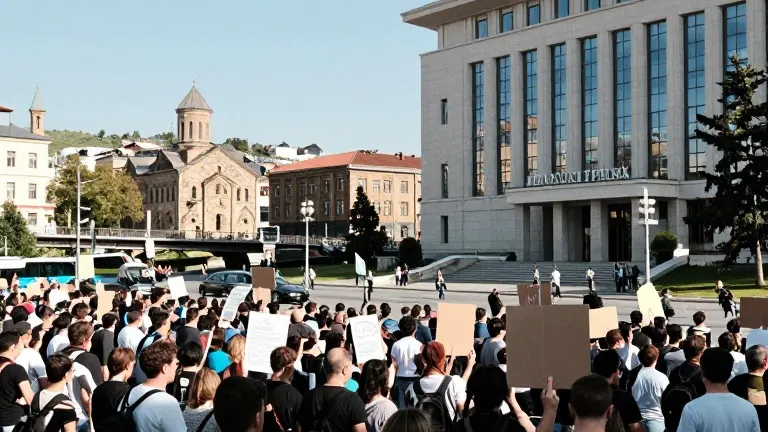
Tbilisi presents a sharp economic contradiction on the two-year anniversary of Georgia’s political crisis. While weekly protests continue to clog the streets of the capital, the national economy posted strong gains in 2025. The country’s GDP increased by 7.5%, marking the fifth straight year of expansion. This growth coincided with a record influx of international visitors.
Data from the Georgian National Tourism Administration shows more than 5.5 million international tourists visited the country in 2025. That figure represents an 8.4% increase over 2024. It is nearly ten times the approximately 560,000 visitors recorded two decades ago. Travelers arrived from across Europe, the Middle East, and Russia, drawn by historic sites, post-Soviet urban landscapes, and rural wine regions.
The protest movement began two days after the contested parliamentary elections on October 26, 2024. Crowds gather every Saturday in Avlabari Square to march toward parliament. They target the Georgian Dream party, which has held power since 2012. The opposition accuses the government of growing authoritarianism and moving closer to Moscow by suspending EU accession talks. Georgia received EU candidate status in 2023, but the government stated in November 2024 that it would not prioritize opening negotiations before the end of 2028.
A large portion of the recent tourist surge consists of Russian citizens. Since Russia’s full-scale invasion of Ukraine in 2022, tens of thousands of Russians relocated to Georgia. They brought capital and opened businesses, which fueled pressure on the local property market. This dynamic has intensified domestic discontent. Many Georgians still view Russia as an occupying power following the 2008 war and the consolidation of Russian control over Abkhazia and South Ossetia, which account for roughly 20% of the territory.
Despite the political tension, economic ties with Moscow remain deep. Russian trade, tourism, remittances, and energy imports continue to prop up the Georgian economy. However, the country faces persistent challenges including unemployment, low wages, and rural depopulation. The relationship with Brussels has also deteriorated, with the EU citing issues regarding the rule of law and political repression.
Georgian Dream founder Bidzina Ivanishvili, who served as prime minister from 2012 to 2013, remains a central figure in the national narrative. He made his fortune in Russia in the 1990s and funded the renovation of the Rustaveli Theatre. The country, which emerged from the Soviet Union in 1991, now finds itself balanced between a vibrant tourism sector and a complex geopolitical position between Russia and Turkey.
The future of Georgia’s political trajectory remains entangled with wider regional dynamics. Observers note that a strengthening of Moscow in the ongoing Ukraine conflict could increase pressure on the Caucasus. For now, the numbers tell a story of resilience in tourism and GDP, even as the Saturday marches continue in the heart of Tbilisi.
Source: The Guardian