Student List's 141 Seats Start Serbia's 90-Day Clock on Government Formation
The movement, which has no designated leader, must form a government within 90 days of parliament's convening, and presidential elections are due before Dec. 27.
By Arjun Tanaka ·
With all ballots counted, the Student List took 53% of Serbia's vote and 141 of the 250 seats in parliament, according to projections from the Centre for Free Elections and Democracy in Belgrade. The Serbian Progressive party, led by Aleksandar Vučić, finished with 39% and 103 seats. National minority party lists took the remaining seats.
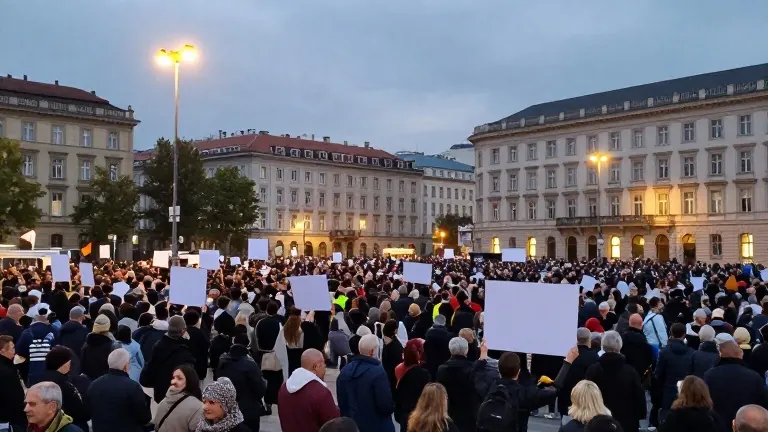
Vučić conceded late on Sunday after 14 years in power. Supporters gathered in the streets on Monday. The election followed two years of protests that began after a canopy collapsed at the Novi Sad railway station, killing 16 people.
Talks on forming a government are set to begin, but the movement has no leader and no hierarchy. Its candidate list included academics, actors, farmers and students. Named figures within the list are Ilija Srdanović, a cardiologist who headed the candidate list; Dejan Šoškić, a former central bank governor; and Radomir Saičić, a chemistry professor at Belgrade University.
The constitution requires the new parliament to convene within 30 days of the official result, and sets a 90-day window after that to form a government. Presidential elections must be held before Dec. 27 because Vučić stepped down to run for prime minister. Ana Mirković, a Student List candidate, said the movement's first priority is the "social and psychological detoxification" of the country.
The platform includes a pledge to fight corruption and restore rule of law. It proposes an independent police unit reporting to prosecutors rather than the interior ministry, and the removal of police officers linked to organised crime. It also calls for a ban on appointing party loyalists to state-owned companies, and for independent review of major state infrastructure contracts.
Vučić's party extended control over media, judiciary and state institutions during his tenure. Elections held under his government were affected by registration irregularities, media bias and voter bribes. After the result, Vučić attributed the defeat to "the direct support of various European countries and the US deep state, the one that is also against President Trump".
Nikola Burazer, programme director at the Centre for Contemporary Politics in Belgrade, said the movement's decision-making process needs to "be sped up", noting that choosing candidates "actually took a long time - months". Dušan Vučićević, an analyst, told Agence France-Presse that the model's reach beyond Serbia is uncertain: "This experiment in grassroots democracy ultimately secured more than 50% of the vote," he said, but it was "unclear whether a similar model could work in other countries".
The Kremlin said on Monday it hoped the new leaders "understand that cooperation with Russia is in Serbia's interests". Ukrainian president Volodymyr Zelenskyy called the result "a new chapter in the history of the country and its people". German chancellor Friedrich Merz said Berlin would "actively support Serbia's European path".
Source: The Guardian